
F1 Trip to Barcelona Guide
A Mediterranean Grand Prix and a Barcelona city break fit together naturally: fast cars by day, tapas bars and sea air by night. A F1 trip to Barcelona places you in one of Europe’s great sporting cities while the racing happens in Montmeló, around 32 km north-east of the centre. Most visitors stay in Barcelona and travel out each day, which is why this is such a friendly choice for first-time F1 travellers. The transport network is strong, the viewing options are varied, and the city gives the weekend a relaxed Catalan rhythm. At Motorsport Travel, we have helped more than 50,000 travellers plan live sport trips, so we know how much smoother the weekend feels when location, travel and planning are thought through properly; Motorsport Travel packages also include a ticket guarantee for peace of mind.
Mediterranean Grand Prix meets Barcelona city break
This Spanish Grand Prix travel guide starts with the simple appeal of the destination. Barcelona gives you Gaudí architecture, the Gothic Quarter, Barceloneta and almost 5 km of city beaches, while the race venue delivers one of Formula 1’s most complete technical tests. For a useful overview of planned race travel, the Spain - Barcelona 2026 page sits alongside event details for the Spanish Grand Prix.
The classic Barcelona F1 weekend works best when you treat it as two connected journeys: a city stay and a daily transfer to Montmeló. That balance is the reason the trip feels accessible. You are not isolated beside a remote venue, but you still get the full race-day build-up, the sound, the heat haze above the asphalt and the long walk back with thousands of fans talking through the key moments.
Circuit de Barcelona-Catalunya character
The Circuit de Barcelona-Catalunya opened on 10 September 1991, with its first Formula 1 Grand Prix held the same year. It was built as part of the wider development around the 1992 Barcelona Olympic Games, and that sense of major-event infrastructure still matters today. The Montmeló F1 circuit is around 18 km from the coast, close enough to feel part of the Barcelona region but far enough from the city to need proper travel planning.
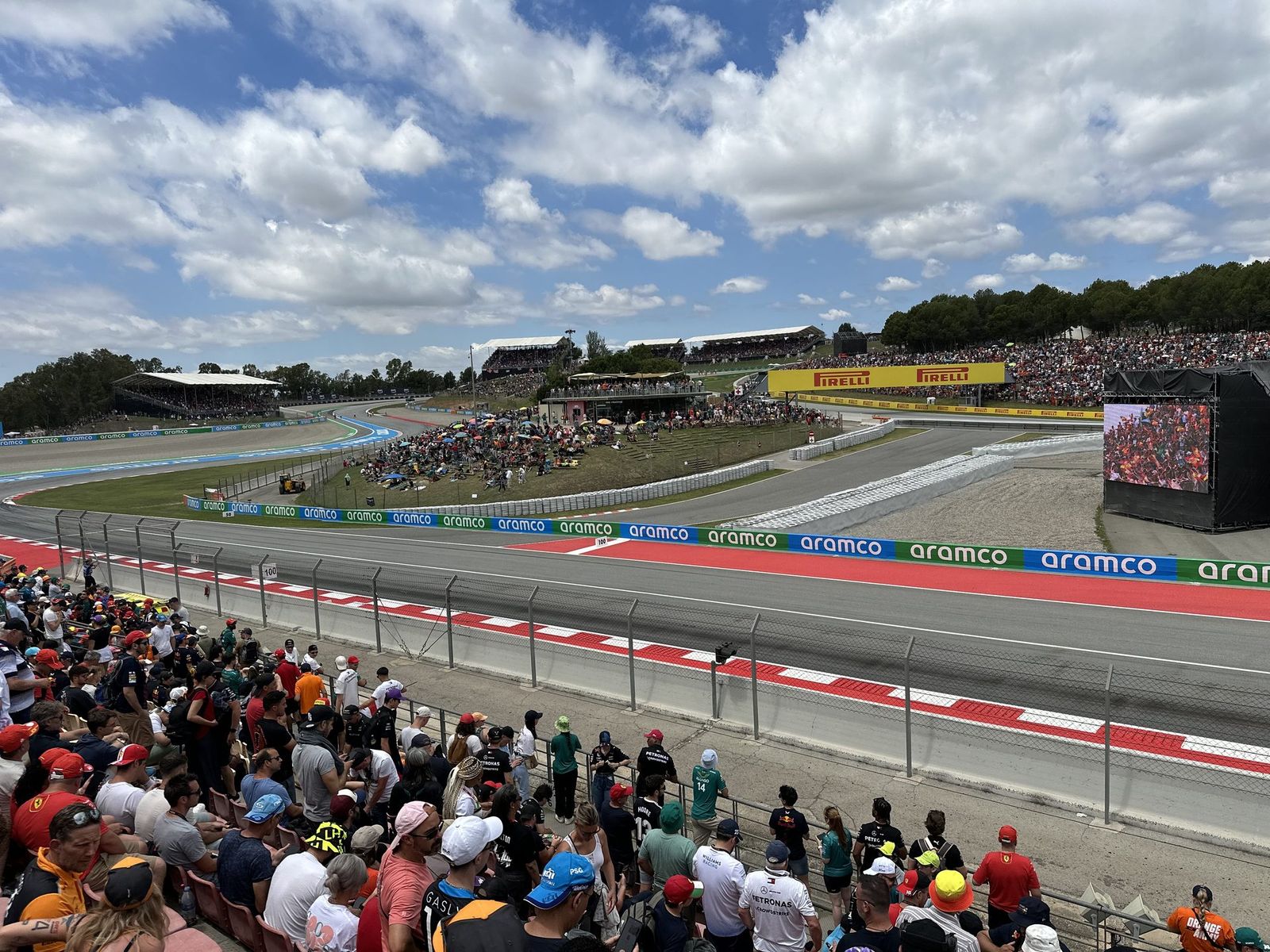
For an in-depth Circuit de Barcelona-Catalunya guide, the numbers tell only part of the story. The current F1 lap is 4.655 km, with the race run over 66 laps, but the character comes from contrast: a long main straight, heavy braking into Turn 1, the sweeping commitment of Turn 3, a technical middle section and a stadium-style final sector. The old final chicane was removed for the 2023 layout, giving the last part of the lap a faster flow with updated safety measures. The venue’s profile is also shaped by its past, from Mansell and Senna running side by side down the straight in 1991, to Schumacher’s first Ferrari win in wet conditions in 1996, and Maldonado’s surprise victory from pole in 2012. The product page for circuit-de-catalunya-f1-track is a useful reference point for the layout, while wider race details sit with the Spanish Grand Prix.
Viewing the race: start drama, fast corners and hillside freedom
Choosing where to watch shapes the whole weekend. The main covered seating area suits first-time visitors who want structure, shade and a clear sense of occasion: grid build-up, pit lane activity, the start, the finish and the podium all feel close from here. Around Turn 1 and Grandstand A, the mood is more intense. This is where DRS-assisted attacks, first-lap tension, restarts and braking battles usually come into focus, making Turn 1 Barcelona F1 viewing one of the most popular choices.
If you prefer flexibility, the Turn 3 general admission banks are a superb way to understand the cars. This long, fast right-hander shows downforce, balance and driver commitment in a way television rarely captures. It is also strong for photography, though you should arrive early for the better sightlines. Later-sector areas offer a more enclosed race feel, with repeated changes of direction rather than a single braking zone. Families often like this part of the venue because the action comes back quickly and the setting feels more contained. The Formula 1 Calendar 2026 helps place the event in the wider European racing year, and the Spanish Grand Prix page keeps the focus on this specific stop.
Gate planning matters more than many newcomers expect. Gate 3 is useful for the main straight area, Gate 6 suits Turn 1 and nearby seating, and Gate 7 works for several later-sector zones and open viewing banks. Fan zones are usually placed around the main spectator side, with activities such as simulators, photo points and family areas, although the exact programme changes from one edition to another.
Where to stay and how to enjoy the city
When thinking about where to stay for the Spanish Grand Prix, transport links matter as much as nightlife. Sants works well for rail access, Passeig de Gràcia is central and connected, and Plaça de Catalunya is handy for city transport, restaurants and sightseeing. Staying closer to the venue can suit travellers who want shorter mornings: Montmeló is nearest but has fewer hotels and dining choices, while Granollers offers more services and is a practical nearby-town alternative. For more city-based ideas, Spain - Barcelona 2026 gives a clear starting point.
A Barcelona F1 city break should leave room for more than the racing. Walk through the Gothic Quarter, look up at Gaudí’s facades, spend time around Montjuïc’s viewpoints and museums, or head to the beach after a long day at the venue. Food planning is simple but important: eat breakfast before leaving, carry water and compact snacks within venue rules, keep lunch easy, then plan dinner back in the city once the busiest return rush has eased. If you are comparing Mediterranean-style racing breaks, Monaco offers a very different coastal setting, while Italy - Monza 2026 is another classic European Grand Prix option.
Practical planning for Montmeló
The main public transport route from Barcelona to Montmeló is by Rodalies/Renfe suburban train. The venue lists R2 and R2 Nord services for Montmeló station, but you should allow extra time for walking, queues, gates and security. Driving can work for groups, mobility needs or stays outside Barcelona, with routes via the C-17 Montmeló exit or the AP-7 exits 13, 14 or 15; exits 14 and 15 connect to the C-17. Expect slow exits after the race. Sagalés local buses, including line 428 between Montornès, Montmeló and Granollers, are more useful for nearby stays than for most central city visitors.
- Arrive Thursday or stay until Monday if you can, because the weekend feels calmer with extra time around the edges.
- Download passes, maps and accommodation details before leaving the hotel, as mobile networks can struggle when the crowd is at its largest.
- Pack sun cream, a cap, sunglasses, comfortable shoes, a light rain layer and a portable charger; June averages near Barcelona Airport are 20.9°C mean, 24.9°C average high and 16.8°C average low, with around 30 mm of rainfall, but exposed queues and open banks can feel hotter than the city forecast.
- Check venue rules before packing: no glass, metal, ceramic or wooden containers, no plastic bottles or cartons over 1.5 litres, no alcohol brought in, and alcoholic drinks are not sold at the venue.
- Leave drones, pets, scooters, bicycles and personal mobility devices behind, and plan your gate before you set off.
For airport arrivals, Barcelona-El Prat is the main gateway. The L9 Sud metro links T1 and T2 with the city in around 32 minutes, though some common passes, including T-casual, are not valid for that airport metro journey. For broader Spanish Grand Prix travel tips and general planning questions, the FAQ is useful, while the Formula 1 Calendar 2026 helps you compare dates and destinations. Plan well, choose your base carefully, and this becomes more than a race weekend: it becomes a smooth, sunlit sporting escape with Barcelona waiting at the end of every day.